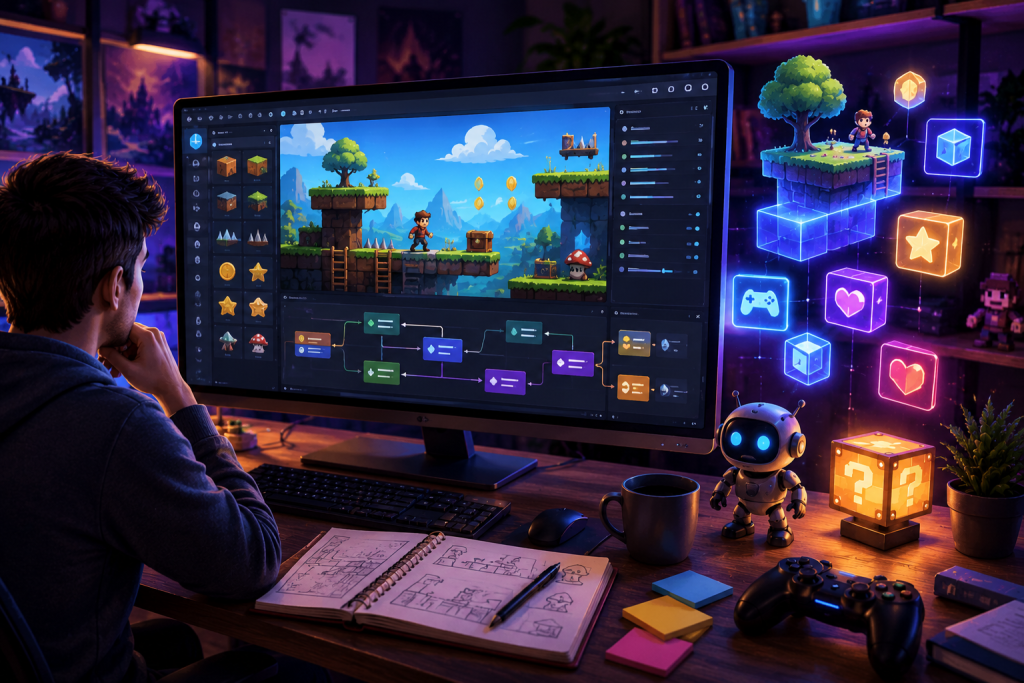
Not knowing how to code used to be the single biggest reason good game ideas never went anywhere. Someone would have a genuinely fun concept sitting in a notes app for years, waiting for a technical skill that never quite got learned. That barrier has largely disappeared, and it’s worth understanding exactly how to build something real without touching a line of code, rather than treating it as some vague shortcut.
Why Coding Was Never the Real Requirement
A good game idea has always come down to instinct: knowing what feels satisfying, what’s frustrating, what keeps someone engaged for one more round. None of that requires programming knowledge. Code was simply the tool that used to stand between an idea and a playable version of it. Once that tool stops being a prerequisite, what’s left is the part that actually mattered all along, the creative judgment behind the idea.
Starting With a Clear Core Mechanic
Define the One Thing Players Will Actually Do
Before building anything, get specific about the single core action your game revolves around. Is the player dodging, collecting, matching, racing, surviving? Every other decision, art style, difficulty curve, level design, should support that one core action rather than compete with it. Trying to build several mechanics at once from scratch is where most first projects stall.
Keep the First Version Deliberately Small
The instinct to build a full game right away usually backfires. A smaller, tightly scoped first version, one level, one mechanic, one clear win condition, gives you something playable fast, which matters far more early on than scope. You can always expand once the core idea proves itself.
How No-Code Tools Actually Build the Game
Describing Instead of Programming
Modern no-code game maker platforms work by translating a plain description of what you want into functioning mechanics behind the scenes. You describe the behavior, jumping, collecting, chasing, and the platform handles the technical execution. This is the part that used to take months to learn and now takes minutes to test.
Iterating Without Needing to Understand the Code Underneath
Once a rough version exists, refining it doesn’t require understanding what’s happening structurally. Adjusting difficulty, changing how fast something moves, or tweaking a reward simply means describing the change you want and seeing it reflected. This is genuinely how anyone can create a game and still end up with something that feels intentional rather than accidental.
Testing Your Game Before You Think It’s Ready
Get It in Front of Someone Else Early
A rough, unpolished version tested with a real person teaches you more than weeks of solo tweaking. Watch where they hesitate, where they lose interest, and where they naturally want to keep playing. This feedback shapes the next version far more effectively than guessing ever could.
Look at What Similar Games Have Already Solved
Studying how a game handles a similar core mechanic is one of the fastest ways to learn what works. Elastic Thief 2 is a useful reference here, a physics-based core mechanic executed with enough polish to show that a simple, well-tuned idea can carry an entire game without needing layers of complexity stacked on top of it.
Common Mistakes First-Time Creators Make
Trying to build every feature before testing the core mechanic is one of the most common traps, since it delays the one piece of feedback that actually matters, whether the base idea is fun at all. Skipping playtesting because the game “isn’t ready yet” is another, when in reality rough versions often reveal more than polished ones. And adding difficulty or content before the fundamental loop is solid tends to bury a good idea under complexity it doesn’t need yet.
What to Focus On Once the Core Works
Once the base mechanic genuinely feels good, attention can shift to pacing, difficulty curves, and small moments of surprise that keep the experience from feeling repetitive. This is also the point where visual polish starts to matter more, since players are more forgiving of rough art in an early prototype than in something presented as a finished game. Building in this order, mechanic first, feel second, polish last, tends to produce far stronger results than trying to perfect everything at once.
Final Thoughts
Creating a game from scratch without coding isn’t a simplified version of real game development, it’s the same creative process with one major obstacle removed. The idea, the iteration, the testing, the judgment calls about what feels right, all of that still depends entirely on the person building it. What’s changed is that the barrier standing between a good idea and a playable game no longer has anything to do with technical skill.