Five things people still believe about the hidden internet, where each belief came from, and what is actually true.
Some internet myths are harmless. Nobody was ever harmed by believing that a website can detect whether you are using a VPN, or that clearing your cookies makes you invisible.
The myths about the dark web are different, because they change what people do. They turn a fairly small technical curiosity into either a forbidden place or a shopping centre, and both pictures lead people to make bad decisions about their own safety.
Here are the ones that will not go away, and what is actually going on.
Myth one: it is a place
This is the root of most of the others. The dark web is not a location with an entrance. It is a way of routing traffic — an overlay on the ordinary internet, where connections take an indirect path so that nobody can easily tell who is talking to whom.
You do not go there. You open a different browser, and the same internet looks different. Once you accept that, the questions change from “how do I get in?” to “what would I be trying to do?”, which is a much more useful question.
Myth two: there is one directory that lists everything
The idea of a single dark web that catalogues the whole thing is the most durable myth of the lot, and it is durable because it used to be roughly true. In the late 2000s there were a handful of community-maintained link pages, and one of them was the obvious place to start.
That ended more than a decade ago. The original was defaced and taken offline, and what remains is a long tail of copies, forks and imitations, many abandoned, some actively hostile. Even the pages that call themselves a dark web wiki will tell you, if you read the small print, that most of their links no longer resolve — and that they cannot vouch for the ones that do.
So “find it on the wiki” is not advice. It is a description of how the problem started.
Myth three: everything there is criminal
By raw service count, the largest categories on any surviving directory are mirrors of ordinary sites, forums, dead links and, increasingly, scams aimed at people who believe the myth. Newsrooms run tip lines. Privacy-focused email providers run onion addresses. The Tor Project publishes documentation there.
This matters, because it is the difference between a tool and a crime scene. Crypto, cash and email are not illegal either, and all three are used by people doing illegal things. The tool is neutral; the transaction is not.
The confusion is understandable, because the illegal parts are the parts that get reported. A seizure produces a press release with photographs. A whistleblowing drop box that quietly worked for another year produces nothing at all.
Myth four: it is enormous
The figure that gets quoted — the dark web is ninety per cent of the internet — is wrong twice over. It confuses the dark web with the deep web, which is the ordinary unindexed stuff like your inbox and your bank. And the original number was a twenty-year-old estimate that its own author later walked back.
The dark web is small. Small enough to walk, badly, in an afternoon. That is part of why the same twenty pages keep appearing: there is not much else to list.
Size matters for a practical reason. A small network is one where a determined beginner can, over a few evenings, see most of what exists. That is not the picture the myths paint, and it changes what you should expect: less a hidden city, more a village with a great many empty shops.
Myth five: you cannot be traced
Tor is good. It is not magic. Investigations usually fail to break the network and succeed by breaking something around it — a payment trail, a reused username, a server that was never hardened, a laptop someone opened at home.
The historical pattern is remarkably consistent. Sites get seized, administrators get identified, and the thing that gave them away was almost never the encryption. It was an operational mistake, and usually a boring one.
Myth six: you need to be technical to find it
Half true, and the half that is false does real damage. Installing the browser is easy: it is a download and an installer, the same as any other piece of software. What is difficult is everything afterwards — judging whether a page is real, deciding what to type into it, and knowing when to close the tab.
The myth tells people that access is the hard part. It is not. Judgement is the hard part, and the myth removes any reason to develop it.
Why the myths survive
Because they are more narratively satisfying than the truth. The truth is that the hidden internet is mostly a slow, ugly, half-broken set of pages maintained by people who lose interest, and that the interesting part is not where you go but what you trust.
The iceberg diagram does the rest of the work. It is memorable, it makes the ordinary reader feel that something vast is being kept from them, and it is drawn by people who have never tried to crawl an onion service. Being memorable is not the same as being right.
There is a commercial reason too. Fear sells subscriptions, and a calm explanation of an obscure routing protocol does not. Several of the outlets that keep the iceberg diagram alive also sell monitoring packages.
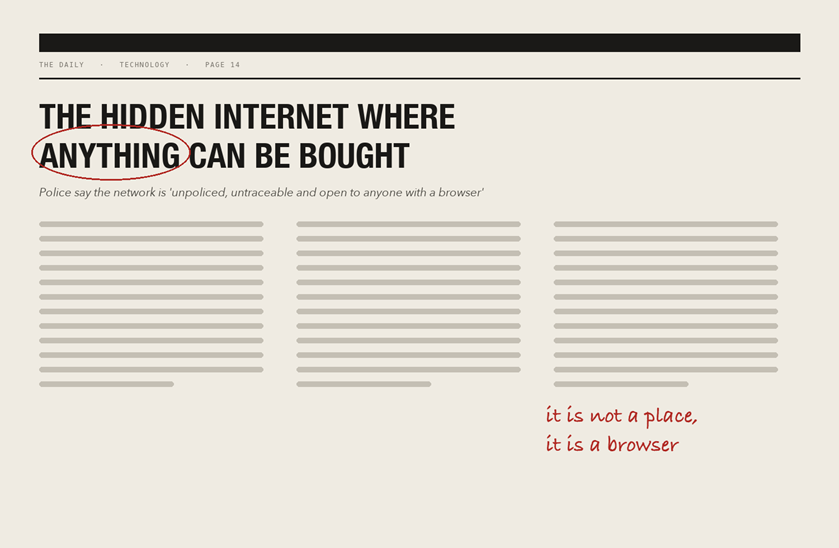
The headline is not a lie exactly. It is a genre.
What is actually worth knowing
That the browser is legal in most countries. That the network is small. That the directories are unreliable. That the scams outnumber the services. That most of what you have read was written by someone selling something — a subscription, a film, an alert service, or a story.
And that the people actually at risk rarely resemble the ones in the stories. A teenager who installs a browser out of curiosity, an adult who clicks a directory link, a small business whose credentials were reused across four services — those are the ordinary casualties, and none of them look like a film.
There is a quieter consequence too. People who believe the myths make one of two mistakes: they avoid a tool that might genuinely help them, or they wander in expecting a marketplace and treat the first page they find as a map. Both errors come from the same wrong picture, and the picture is easier to sell than the correction.
The most useful correction is not a fact but a question. When you meet a claim about the dark web, ask what kind of claim it is — about indexing, about reach, or about routing. Most of the bad writing mixes all three, and most of the confusion lives in the mixture.
And that the single most common way people get hurt on the dark web has nothing to do with the dark web. They use a password they have used for years, on a site they found on a list, and lose an account they actually cared about.
Notes for the editor
- Angle: myth-busting in list form, matching the site’s tips-and-tricks format.
- Links: two contextual, both on the single-directory myth, to different pages.
- Images: one original illustration, also supplied as a standalone PNG.
- Neutral on legality; no jurisdiction-specific claims.