Introduction
Designers and engineers who implement their designs in physical prototypes, using 3D printing technologies such as FDM, SLA, SLS, and PolyJet, are often faced with a dilemma in selecting the most appropriate technology for their design, since the wrong choice can be catastrophic, e.g., a prototype intended for mechanical tests is created using a brittle resin, or a prototype intended for form fit is created using a very expensive technology such as multiple materials. Research has shown that up to 30% of prototype iterations and budget wastages are caused by the wrong choice of technology, arising from a mismatch between the technology chosen and the most important validation requirement. This is mainly because decisions are made based on vague criteria such as “precision” or “cost” instead of making decisions based on the precise fit between the most important capabilities of each technology and the most important goal of the design, whether it is form fit, function, or user experience. Each technology is a “specialized tool” for solving a particular problem.
In this article, a “Goal-Driven 3D Printing Technology Decision Framework” will be offered, going beyond the comparisons of parameters to a thorough examination of the absolute strengths and weaknesses of each technology (FDM, SLA, SLS, PolyJet) in addressing different needs: structural, aesthetic, functional, and multimaterial simulation capabilities. This framework allows you to “lock in” the most cost-effective and efficient technology path for each prototyping phase, avoiding as much as 25% of unnecessary costs and weeks of project delays. To fully understand this framework, a “Primary Mission” of your prototype needs to be clearly articulated.
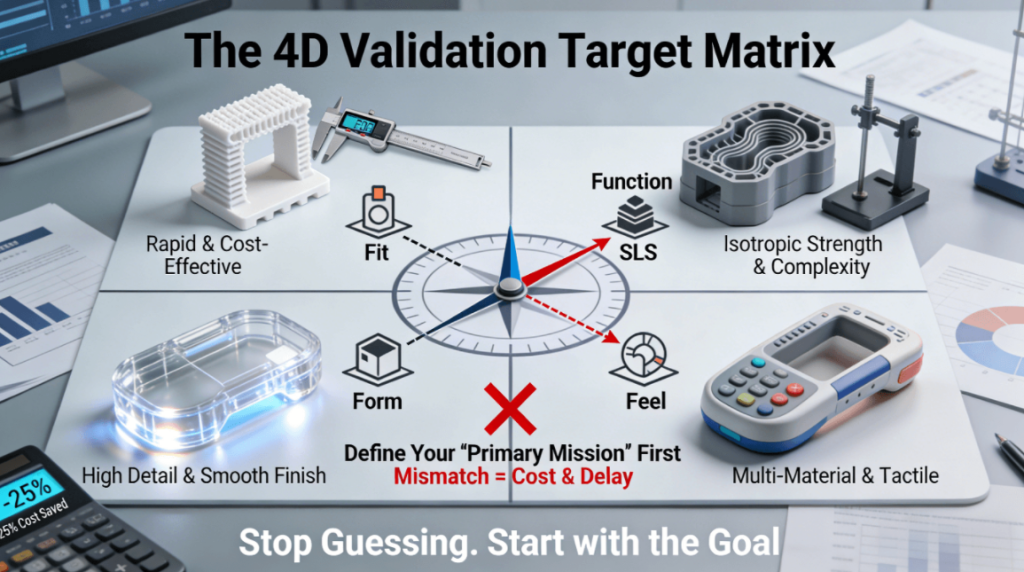
What is Your Prototype’s “Primary Mission”? Fit, Function, Form, or Feel?
The purpose of this section is to lay the groundwork for the decision process by clearly articulating the fundamental objective of the prototype, as trying to fulfill multiple objectives with a single technology can be wasteful.
1. Fit: The Need for Spatial Verification
The “Fit” mission is about spatial verification – will part A fit with part B? The main requirements are speed, cost, and accuracy. Strength, surface finish, and material properties are secondary considerations. This is a common mission in the early design phases, especially when designing something such as a bracket, enclosure, or mechanical assembly. The technology used in this mission must be fast and inexpensive, as the part’s sole purpose is to be measured, assembled, and eventually discarded. This goal-oriented approach is in line with the fundamental principles of Design for Additive Manufacturing (DfAM).
2. Function: The Test of Performance
The “Function” mission is critical since the prototype has to perform in real-world conditions. It could need to withstand mechanical, thermal, chemical, or fatigue stresses. In this mission, the mechanical properties of the material are of critical importance. Isotropic strength, isotropic resistance to heat, or isotropic durability are needed from the technology. This is the mission for parts like functional tests, parts for load-carrying brackets, and parts for fluid handling. It is a costly error to pick a technology based on surface finish for a functional test.
3. Form & Feel: The Realm of Aesthetics and Experience
The “Form” aspects center on visual and ergonomic verification. The prototype must be a precise representation of the final product’s form, feel, and ergonomic characteristics, including resolution, smooth surfaces, and possibly transparency. “Feel” takes this a step further by including a tactile representation of the final product, possibly including a combination of soft-touch and hard materials or different transparence levels in a single part. These missions are critical for consumer products, medical devices, and UI prototypes. To help you fully comprehend this topic, including quantitative information and verified selection logic for these four technologies, this comprehensive 3D printing rapid prototyping services guide will include an extremely detailed comparison and analysis.
FDM vs. SLA: Is This a Battle of “Strong & Cheap” vs. “Smooth & Precise”?
This section will give a detailed and data-driven comparison of the two most accessible technologies: Fused Deposition Modeling and Stereolithography. This will help readers understand that these two technologies have different and non-interchangeable missions.
1. FDM: The Workhorse for Structural Prototyping
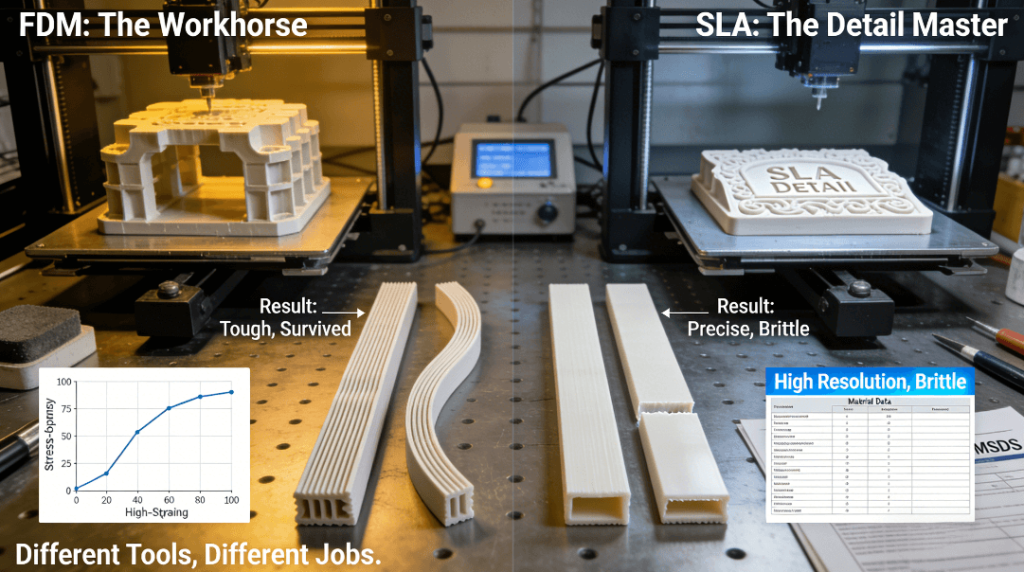
FDM 3D printing technology refers to a process where a “thermoplastic filament” is extruded in a “layer by layer” fashion. What makes the FDM 3D printing process unique is the variety of engineering “thermoplastics” used, which are “cheap.” Thermoplastics, such as ABS, Nylon, and PETG, are known for having good “toughness, heat resistance, and strength-to-weight ratios”; therefore, the FDM 3D printing process is best suited for the “Function” mission because “it’s the cheapest method to make function prototypes, fixtures, and parts.” However, having a “layer by layer” structure results in a product having “visible layer lines”, “anisotropic strength” (i.e., the product is weaker than usual), “requires support structures,” and is a tool for “strength and durability, not fine features.”
2. SLA: The Master of Detail and Surface Finish
The SLA 3D printing technology makes use of a laser beam to cure the liquid resin into a 3D object. The advantage of this technology is its capacity to produce detailed and smooth results. It has the capacity to produce layers as small as 25 microns. This makes the technology produce smooth results without any visible layers. It is therefore the winner in the “Form” mission because the precision in the form is paramount in producing accurate models and parts. However, the resin produced has the disadvantage of being brittle and decaying when exposed to UV rays. It is therefore not appropriate for producing parts meant for use. It is a technology for producing form and detail.
3. The Strategic Choice, Not a Trade-off
Selecting between FDM and SLA is not a trade-off; it is a strategic choice of technology for a task. It is a choice of using FDM for rapid prototyping when the parts need to be strong, tough, and able to withstand heat, and using SLA 3D printing services when the parts need to have a high finish and smoothness. This is one of the basic cost-saving tips.
When Does SLS Become the “Dark Horse” for End-Use Parts?
This section will expose the unique value proposition of Selective Laser Sintering (SLS), which makes it the best technology for complex functional prototypes and end-use parts.
- The Power of Powder: Design Freedom and Isotropic Strength: For the “Prototyping” mission, the process involves using the laser to sinter the powder based on the design. This is different from FDM and SLA, which require support structures since the unsintered powder supports the part during printing. This gives it unprecedented design freedom since it can print complex internal channels, living hinges, and interlocking mechanisms in a single print. More importantly, it has near-isotropic mechanical properties, which means that the part has the same mechanical properties in any direction, making it similar to injection-molded parts. This is the reason it is the best technology for the “Function” mission involving complex functional parts.
- The Economics of Batch Production: While it is true that the initial cost of machines for SLS is higher than for FDM, it should be understood that the cost of production for SLS is also unique in that it is able to accommodate densely packed powder in the build chamber, thus enabling economies of scale in production cost as the build size is utilized. When it comes to making 10 to 50 copies of functional prototypes or end-user parts, it should be understood that SLS is actually the most cost-effective option, surpassing both FDM and SLA in cost per part for functional, strong, and complex nylon parts.
- The Ideal Application Space: SLS is best used when there is a need for functional parts that are also complex in nature. Therefore, when functional prototyping is finished and there is a need to move seamlessly from prototyping to pilot production or part production, it should be understood that integrated rapid prototype machining services that bring together 3D printing and CNC machining may be of greater use to the user.
PolyJet’s Magic: Is It Worth the Premium for Multi-Material Illusion?
This section will present a balanced view of the PolyJet technology by focusing on its unbeatable capacity for producing multi-material product simulation.
1. Unmatched Multi-Material and Color Capability
PolyJet technology is based on a 3D printing technology similar to a high-resolution inkjet printer. It ejects small droplets of photopolymer resin, which are then immediately hardened using UV light. The special feature of the technology is its capacity for printing multiple materials at the same time. It can print materials of different colors and varied Shore A hardness ranging from 27 to 95. It can also print materials of varied opacity and biocompatible materials. It is the ultimate technology for the “Feel” mission.
2. The Trade-offs: Cost, Durability, and Purpose
The price for this capability is high. PolyJet is normally the most costly technology on a per-part basis. In addition, while these photopolymer materials perform well in a simulation environment, they are not engineered for long-term durability or exposure to harsh environments, where they can be susceptible to “creeping” over time under load. The value in PolyJet is not in creating a functional part but in creating a highly detailed visual and tactile prototype that helps users test their designs, communicate with stakeholders, and validate their designs prior to committing to costly production tooling. It helps us optimize our designs critically before we manufacture them.
3. A Strategic Investment for De-Risking
A strategic investment in a PolyJet prototype is a strategic decision for de-risking a product development project. We can solve complex questions about how users will interact with a product, how it will be assembled, etc., questions we can’t answer with other technologies, questions that can save us hundreds of thousands in tool rework. We need this tool for validation, not for end-use.
Beyond the Printer: How to Audit a 3D Printing Partner’s True Capability?
This section is the checklist for the audit of a 3D printing partner. It discusses the unseen aspects of a 3D printing partner’s capability, which distinguish good 3D printing companies from average ones.
- Material Science and Data Transparency: A good partner is not only able to provide the materials they use, they must also be able to provide or reference the material data sheets that the materials they use have, such as the mechanical properties they have, including the tensile strength, elongation at break, and the HDT they have. They must also be able to comply with the material safety regulations that the industry they serve has. They must be able to provide the stress-strain curve data that the type of nylon they use has in the SLS printing process.
- Mastery of the Entire Value Chain: Post-Processing: The quality of a 3D printed object is often determined by post-processing. Ask them about their post-processing capabilities: What is their approach for achieving optical clarity for SLA? What is their approach for achieving complete depowdering for internal channels in SLS? A supplier’s mastery of post-processing operations such as sanding, dyeing, vapor smoothing, painting, and clear coating can make a big difference in how quickly your prototype is ready for its purpose. That’s a key element in a complete rapid prototyping services solution set.
- Systematic Quality and Advisory Partnership: Lastly, it is also important to evaluate their systematic approach to quality. Do they have a controlled environment for consistent results – temperature and humidity-controlled? Do they provide basic inspection results? But most importantly, do they provide Design for Additive Manufacturing (DFAM) feedback to ensure your part is optimized for their process, minimizing supports, materials, and achieving optimal results? When you find a supplier that incorporates this type of partnership, you are no longer just working with a supplier – you are working with a partner in development, which is part of a thorough evaluation of your supplier. For high-risk application scenarios, ISO 9001 provides guidelines for such systematic quality control; regarding material safety, relevant standards from the U.S. Environmental Protection Agency(EPA) may be referenced.
Conclusion
In a world where rapid prototyping is possible, there is no ‘best’ technology, only ‘the most appropriate’ for your current validation need. In embracing a goal-oriented approach to technology selection based on Fit, Function, Form, and Feel, we can take 3D printing from a laundry list of confusing choices and turn it into a precise and efficient means of product development. Not only can we directly eliminate precious development dollars and time, we can ensure that each version of our prototypes delivers the greatest value in the least amount of time possible.
FAQs
Q: I want to design a prototype that is not only strong but also has a smooth finish. Is there one method that can fulfill these two requirements?
A: This is a very common problem. FDM is strong but has layer visibility. SLA is smooth but has poor strength. If the prototype requires strength and finish, one solution is to combine SLS with Nylon. This will provide strength and a smooth finish that can be polished. Another solution is to select a strong FDM material and spend time and money on finishing the prototype.
Q: How much does post-processing add to the lead time and cost?
A: Post-processing is a big aspect that is not taken into consideration. In the case of the SLA machine, washing and curing can take a few hours. In the case of smooth finish parts, it can take 1 to 3 days and can increase the cost by 20 to 50 percent. In the case of SLS machines, the parts have to be removed from the powder, but this is already included.
Q: What’s the cheapest method to make 10, 50 identical, working prototype models?
A: When it comes to manufacturing 10 to 50 prototypes of the same product, SLS might be your best bet for the cost, effective production of quality, durable prototypes. This is mainly because the build chamber can be fully utilized, and the prices can be very closely aligned with the manufacturing of rugged nylon components. This is not the case with FDM and SLA technologies.
Q: I wonder how I can tell if 3D printed prototypes are good enough to be working at very high temperatures, e.g. in a car engine compartment?
A: In general, the standard materials are not the right choice for working at very high temperatures. If you want your prototypes to withstand working at high temperatures, then you will have to go for some special materials, e.g. High, Temp SLA Resins PEEK ULTEM, or High, Temp Nylons. However, such materials come at a higher price, but suitable printers are out there in the market. Also, take note of the Heat Deflection Temperature of the materials used.
Q: How do I prepare my CAD file to get the best results and an accurate quote?
A: For the best results and an accurate quote, prepare a 3D model of your part that is watertight and without any errors. It’s best if the file is in STEP or IGES format.Most importantly however is to clearly communicate the purpose of the prototype (Fit Function Form, Feel) to the supplier of the prototypes..
Author Bio
The content draws from a deep and practical understanding of additive manufacturing, offering customers end-to-end solutions from prototype to production in several industries. Being a certified manufacturing partner (ISO 9001, IATF 16949, AS9100D), LS Manufacturing’s team has a broad understanding and capability in the areas of both 3D printing and rapid manufacturing, opening avenues for partners to make the most well, informed decisions regarding technology. Still hesitant about your next prototype project? Upload your CAD file today and obtain your free report on Prototyping Technology Path & Cost Optimization Recommendation.